
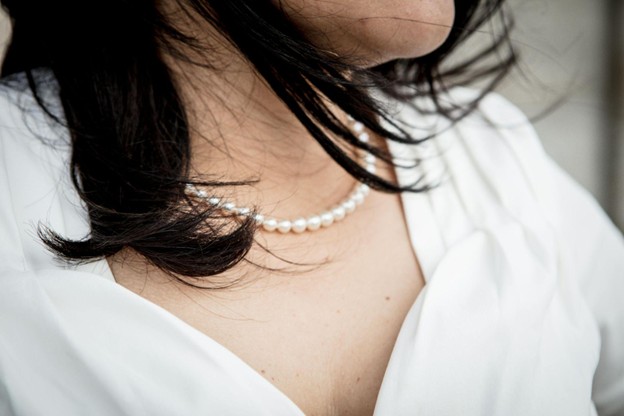
If you’ve been following Sparkles & Stretchmarks for any amount of time, you know that turning 40 was a game changer for me. Being a working-class kid from Liverpool, fine jewelry was never something I grew up with or believed to be meant for people like me. For decades, my jewelry box consisted solely of high-street costume jewelry, fun trinkets, and “pearl” necklaces made of plastic bought impulsively.
But then I turned 40 and things changed. It could be the milestone birthday, but maybe also the point when I finally accepted myself and embraced who I am. I understood that it’s time to stop wasting money on cheap costume metal and plastic beads that will end up in the landfill after three wears. 40 is the age to stop buying fakes and start investing in pieces that will last—pieces of real heirloom quality that will make you feel quietly grounded and put together even in your leggings.
Buying my very first set of freshwater pearl necklaces left me feeling completely lost and helpless. I didn’t understand the terminology, the prices varied greatly, and I was afraid of being scammed. Here is the straightforward buying guide to help you get your first real piece of jewelry when you are ready to treat yourself.
Why 40 is the Milestone to Ditch the Fakes
When we are in our twenties and thirties, fast fashion and costume jewelry may be considered convenient and cool. However, as soon as we enter our nineties and beyond mentality (or our fabulous 40s!), our attitude to things changes.
Fake plastic and glass imitation pearls have no warmth. They are prone to chipping and peeling and are absolutely weightless. The real pearls produced by living mollusks have a special weight, warmth, and luster that makes everything better immediately – whether it is a fitted blazer or an oversized knit.
- How to Identify Real Pearls From Fake Pearls
Before paying even one cent for anything, you should learn how to identify a real pearl from a factory-made fake. There is no need to be a gemologist; it is enough to conduct just four simple tests:
- Tooth Test: Rub a pearl against the surface of the tooth (not the edge). Real pearls consist of very thin layers of nacre and therefore can be a little rough in texture. Fake pearls, made from glass or plastic, will slide smoothly without sticking at all.
- The Temperature Test: Natural pearls are cold at the beginning (when you first take them into your hand) and gradually warm up. Pearls made of plastic and other materials maintain the temperature of the surrounding air.
- Weight Test: When you take pearls in your hand to feel their weight. Real pearls are heavier than plastic replicas.
- Imperfection Test: Nature is not perfect. If all the pearls in the necklace look the same in size, shape, and color, then they are most likely fake. Real pearls always have some irregularities in their shape and color.
- Freshwater vs. Saltwater Pearls: How Are They Different?
When shopping for your first piece of jewelry, you will find that there are two basic kinds – freshwater and saltwater.
- Freshwater Pearls
Produced in mussels in lakes and rivers, they are very durable because of the extremely pure composition of nacre. They can be found in various shapes, from baroque to almost round, and in natural colors such as white, peach, lavender, and other colors.
The biggest advantage is that they combine luxury and an affordable price. It would be nice to look at the collection of freshwater pearl necklaces in case you wish to purchase your first real pearls.
- Saltwater Pearls (Akoya, Tahitian, South Sea)
Produced in oysters in saltwater, they are famous for their extremely high mirror-like luster and perfectly spherical shape. However, they are significantly more expensive and require proper handling.
In your case, high-quality freshwater pearls are a perfect choice that combines elegance, durability, and realistic pricing.
- Pearl Size & Necklace Length for Your Neckline
Matching pearl size and length to your taste and wardrobe will ensure that you will actually wear them.
Pearl Sizes
- 6mm – 7mm: Delicate and perfect for casual daily wear or layering with fine gold chains.
- 7.5mm – 8.5mm: Classic pearl size. Not too big but still eye-catching.
- 9mm+: Large, dramatic pearls that look perfect for evening wear or making a bold style statement.
Necklace Lengths & Necklines
- Choker (14–16 inches): High necklace that sits right on your collarbone. Looks good with high crew necks, off-the-shoulder clothes, and strapless dresses.
- Princess (18 inches): The most universal length. Falls right below your collarbone and looks easy to wear with a V-neck, button down, or simple T-shirt.
- Matinee (20–24 inches): Necklace that reaches the top of your bust. Great for turtlenecks, business suits, and layered outfits.
- How Much You Should Pay (And Why)
Real pearl prices range from £50 to thousands of pounds, and it is not surprising that most people get confused about how much they should pay.
How does the price depend on the qualities of the pearl?
- Luster: The deeper and sharper the reflections of light, the higher the price.
- Surface: The fewer the spots and pits on the surface of a pearl, the more expensive it is.
- Shape: Rarer round pearls are more expensive; baroque pearls are an interesting choice that will not empty your pocket.
- Matching: Matching a pearl necklace is a long process that costs money; therefore, full necklaces are more expensive than individual pendants.
The price of an excellent-quality freshwater pearl necklace varies from £100 to £300. Extremely inexpensive pearls (less than £30) are rejected or artificial pearls, and exaggerated designer prices sometimes cover only the brand name.
Wearing pearls for the first time at the age of 40 is not an attempt to show off but a sign of respect for yourself and choosing quality over quantity, and wearing something real that brings you joy every single day.